


.svg)





.png)


Over the past year, one of the most consequential debates in real estate has centered on a topic that sounds straightforward on the surface: listings. But the conflict playing out between Zillow, Compass, and MLS organizations is not really about who gets to see a home before it hits the market. It's about who controls the relationship with consumers in an increasingly digital industry, and the answer has real implications for every agent building a business right now.
The short version: Zillow sued Compass and Chicago-area MLS MRED in May 2026, alleging the two conspired to hide listings from buyers and pressure Zillow into abandoning its transparency policies. What followed was a rapid escalation, including a feed cutoff that briefly removed roughly 43,000 active listings from Zillow and Trulia, a federal injunction, and ongoing litigation that has yet to be resolved. At the same time, the industry has undergone dramatic consolidation, with Compass acquiring Anywhere Real Estate (parent of Coldwell Banker, Century 21, and Sotheby's) in January 2026, and Rocket Companies purchasing Redfin. Both Zillow and Compass now control enough market share that when they change their rules, the effects ripple across the entire industry.
The surface debate is about listing visibility. The deeper issue is about attention, influence, and who owns the consumer relationship when a buyer or seller is ready to make a move.
The Fight Everyone Sees
At the center of the dispute is a question about listing control. Should homes be publicly available to buyers as quickly as possible, or should sellers have more flexibility in how and when their properties are marketed?
Compass has built a business model around "Private Exclusives," homes marketed within its agent network before they hit the MLS. The brokerage argues that some sellers benefit from testing the market privately before a public launch. Zillow counters that broad listing exposure produces better outcomes for sellers and that buyer access to full inventory is a consumer protection issue, not just a business preference. In April 2025, Zillow updated its listing access standards, effectively banning properties from its platform if they had been marketed privately for more than 24 hours before going on the MLS. Compass filed suit against Zillow the following month, arguing the policy was designed to suppress competition.
Each side has genuine arguments. The conflict escalated sharply when, according to Zillow's federal complaint, Compass CEO Robert Reffkin contacted at least eight regional MLSs urging them to cut off Zillow's data access if the portal did not reverse its transparency standards. MRED, which processed more than 264,000 listings worth $43 billion in 2025 and controls the listing data pipeline for the greater Chicago area, agreed. In early May 2026, MRED demanded Zillow comply with new rules that would have required it to display Compass private listings regardless of its own platform policies, then threatened to terminate Zillow's access to the entire Chicago feed if it refused.
When MRED followed through, approximately 43,000 active listings disappeared from Zillow and Trulia overnight. Zillow immediately filed for a preliminary injunction, and within days, U.S. District Judge John Tharp Jr. ordered MRED to restore the feeds. The injunction remains in place while litigation proceeds, with a hearing on Zillow's preliminary injunction motion scheduled for early July.
The Fight Happening Beneath the Surface
Framing this as a policy debate about transparency misses the bigger story. What Zillow, Compass, and every major MLS organization is actually competing for is consumer attention, and listings are the most powerful tool in that competition.
Every new listing creates an audience. Buyers search for it. Neighbors benchmark their own home values against it. Past clients forward it to friends who might be thinking about moving. A listing that generates thousands of views is not just a home for sale. It is an entry point into a relationship, and that relationship can eventually lead to a buyer consultation, a future listing appointment, or a referral years down the road.
This is why the stakes in the Zillow-Compass dispute are so much higher than listing display rules. Platforms that capture consumer attention at the start of the buying or selling journey gain a structural advantage that compounds over time. The consolidation happening across the industry reflects this reality directly. As noted in recent reporting on the consolidation wave, both Zillow and Compass have reached a scale where their policy decisions carry industry-wide consequences, a position that both companies have used aggressively over the past year.
For agents, watching this play out from the sidelines is not a neutral position. The platforms and policies being contested right now determine which leads go where, which listings get seen by whom, and ultimately which relationships get initiated.
What This Reveals About the Future of Real Estate Marketing
Regardless of how the litigation resolves, the conflict has already surfaced a set of lessons that are relevant to any agent thinking about how to build a durable business. The platforms will keep fighting over distribution rules. The more useful question is what that fight tells you about where the industry is heading and what to do about it.
Visibility Is Getting More Competitive
Today's buyers and sellers enter the market already informed. They have browsed listings, compared neighborhoods, read agent reviews, and formed opinions before making a single phone call. That shift has been happening for years, but the pace is accelerating as AI-powered search and aggregator platforms make it easier to find information without ever contacting an agent directly.
Visibility is no longer simply about being present across channels. It is about being discoverable at the specific moments that actually move someone to act and then sustaining enough of a presence that your name comes to mind when they are ready. The Compass-MRED effort to restrict listing distribution to certain platforms is, at its core, an attempt to control which agents and brokerages are present at those moments. That play benefits large brokerages with private networks. Independent agents and smaller teams who build multi-channel visibility across both owned and rented audiences are less exposed to the outcome of any single platform decision.
The practical takeaway: relying on one portal or one listing syndication path to generate awareness is a fragile strategy. Agents who create consistent presence across search, social, local content, and direct outreach are building something more durable than any single feed agreement can provide.
Your Database Is Your Most Durable Asset
One of the clearest signals from this dispute is the risk that comes with depending on third-party platforms to connect you with future clients. Platforms change their rules. MLSs restructure their policies. Algorithms get updated. A well-maintained database of people who already know and trust you does not change with any of that.
Every lead source, every listing, every referral ultimately points toward the same objective: adding a real person to a database that you own and can continue to serve over time. That ongoing relationship, consistently nurtured through relevant follow-up and communication, is what turns initial interest into closings and closings into repeat business and referrals.
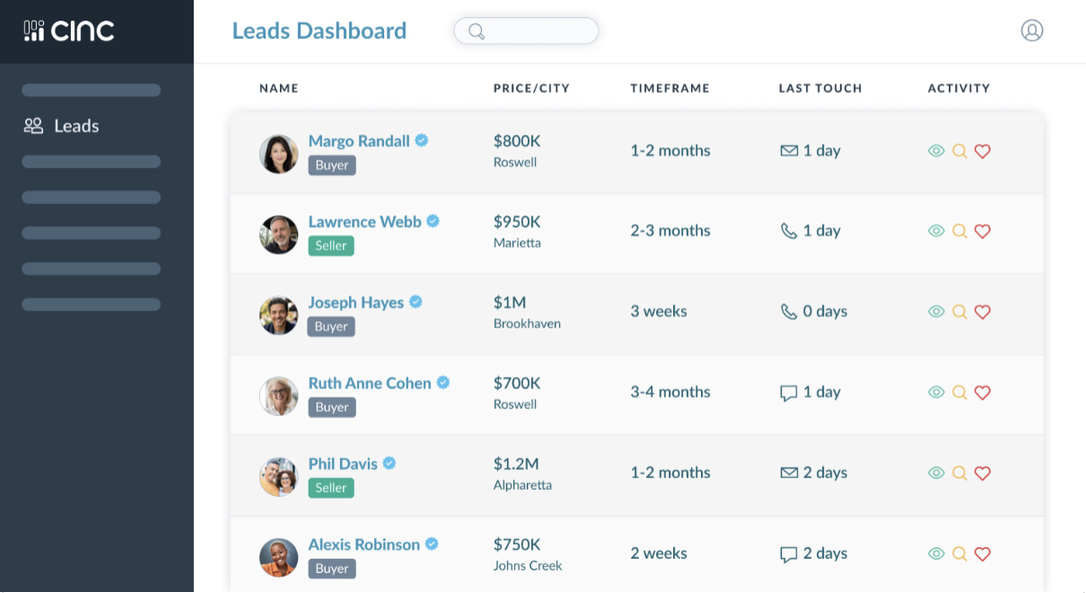
This is exactly where technology earns its value. At CINC, we built our platform around a demand-first approach because lead quality is what makes every downstream capability, from automated follow-up to AI-powered engagement, actually work. Capturing high-intent buyers through hyperlocal campaigns is only half the equation. The nurturing that follows, across months and sometimes years, is what converts a database contact into a closed transaction.
Diversification Is Your Defense
The agents most exposed to industry disruption are those whose business depends on a single channel. When that channel becomes more expensive, more competitive, or simply less effective, there is no cushion. The Zillow-MRED standoff is a concrete example of what that exposure looks like: roughly 43,000 active listings briefly disappeared from a major portal because two organizations could not agree on display rules. Sellers in that market lost visibility. Agents lost leads. None of them had any control over the outcome.
Referrals, past clients, paid digital campaigns, organic search, social content, and community presence all contribute to a pipeline that can absorb change. When one source slows down, the others keep generating opportunity. Building that kind of diversified pipeline is not about abandoning what works. It is about making sure that no single rule change, algorithm update, or platform dispute can take down a meaningful portion of your business.
Having a CRM that tracks all of this in one place matters more than most agents realize. When your lead history, communication log, pipeline stage, and behavioral data all live in the same system, you can actually act on the information. You can see who's browsing, know when to call, and follow up with context instead of starting from scratch every time.
CINC is built around that idea: lead generation, CRM, automation, and a consumer search site integrated into a single platform. Many of the tactics in this post work with any good CRM, but agents who use CINC get the added benefit of having their marketing data and their contact database in the same place. That connection, from first click to closed deal, is what makes the database worth working in the first place.
Technology Moves Fast; Trust Is Still the Differentiator
AI and automation have made it easier to reach more people, respond faster, and maintain communication at a scale that was not practical a few years ago. Both Zillow and Compass have made significant investments in AI-powered tools as part of their broader competition for consumer attention. That investment is trickling down to agents in the form of better platforms, smarter follow-up tools, and faster lead engagement.
But when consumers have access to the same information on a dozen platforms and can compare agents with a few taps on their phones, what distinguishes one agent from another is not the technology they use. It is the credibility they have built and the relationships they have earned. Technology can help agents communicate more consistently and follow up more reliably. It cannot manufacture trust from scratch, and no platform can build it on your behalf.
What Agents Should Focus on Right Now
The outcome of the Zillow-Compass litigation is uncertain. The hearing scheduled for early July could shift the balance of power between major platforms, and the broader consolidation wave reshaping the industry is far from over. Rather than waiting to see how it resolves, agents can use this moment to honestly evaluate the foundation their business is built on.
A few questions worth sitting with:
-
How much of your current pipeline depends on a single lead source or platform?
-
How consistently are you nurturing the relationships already in your database?
-
What percentage of your business comes from people you have a direct relationship with, versus people routed to you through a third party?
-
If any one platform changed its rules tomorrow, how would that affect your business six months from now?
The agents who come out of this period of industry disruption in a strong position will likely share a few things in common. They built visibility across multiple channels. They invested in their databases as long-term assets. They used technology to stay consistent, not just to chase volume. And they focused on earning trust in ways that no platform change can undo.
The Real Lesson Behind the Debate
Zillow, Compass, and MRED will continue litigating. New policies will emerge, and the consolidation reshaping the industry will continue to produce new alignments and new disruptions. But the underlying dynamic driving all of it is the same one that has always determined who wins in real estate: access to the consumer at the right moment, and the trust to convert that moment into a relationship.
Listings create attention. Marketing creates visibility. Technology helps facilitate connections at scale. What turns those connections into a business that grows over time is something none of these platforms can provide for you.
The companies fighting over listing distribution today are really competing for consumer relationships. For agents, the most effective response is not to pick a side in that fight. It is to build the kind of business that does not depend on any one of them winning.