


.svg)





.png)


Do you know how many people get paid in a real estate transaction?
Not 1. Not 5. Not even 10. It's 37.
As an agent, you're one of 37 people getting paid on a single deal.
That realization hit Josh Rumble hard. It’s what sent him down a path that changed the way he runs his team.
Josh is a real estate agent and team leader who has been a CINC client since 2014. He joined Troy Mixon, CINC’s Director of Strategic Partnerships, for a webinar focused on what agents can do outside the platform to drive more revenue. The topic: getting your mortgage license and integrating a lending component directly into your real estate business. What followed was one of the more practical, no-fluff conversations we’ve hosted, and the questions that poured in from the audience confirmed that agents are hungry for this.
The 37-Person Problem That Changed Josh’s Thinking
Josh traces the idea back to a study from around 2018. A typical residential transaction involving a buyer, a seller, both agents, and a government-backed loan has roughly 37 people who get paid when it closes. Appraisers, title reps, processors, underwriters, inspectors, and on down the line.
The uncomfortable question Josh asked himself: how many of those 37 am I?
One.
“I was on a team and didn’t even know it,” he said. That moment of clarity pushed him to figure out how to capture more of the economics in the transactions he was already generating.
The Case Is Even Stronger When You’re Running on CINC Leads
Here’s where this strategy connects directly to how CINC clients do business.
CINC is built on a demand-first model, which means leads come in through hyperlocal paid search campaigns targeting buyers actively searching in specific markets. These aren’t cold names on a list. These are people higher in the funnel who haven’t yet done anything, including figured out their financing.
His point about PPC leads is direct: when someone clicks a search ad and registers on a real estate website, they are almost always pre-mortgage, meaning they haven’t spoken with a lender yet.
That’s not a weakness in the lead. It’s an opening.
“When you catch them a little higher in the funnel, that’s the next logical step for them,” Josh said. Seven out of ten residential buyers nationally require financing to close. In Josh’s market, it’s closer to nine out of ten. Every time an agent working CINC leads makes contact, odds are strong that person needs to have a mortgage conversation. The agent who can initiate that conversation and control where it goes is in a fundamentally different position than one who has to hand it off and hope.
The system does the long-term nurturing. CINC’s CRM captures behavioral signals over months, and property alerts keep leads engaged until they’re ready to act. But the agent who can step into that conversation with a mortgage-first approach has tools to connect with leads more naturally, overcome financial objections in real time, and set a consult that’s easier to schedule than a buyer walkthrough.
Josh’s team sets about 40 lending consults a week. That volume comes directly from integrating mortgage into how they work the database
What “Mortgage First” Actually Means
Josh’s approach isn’t about becoming a loan officer. It’s about reordering the conversation.
Most agents wait until a buyer is under contract before mortgage even comes up. By that point, the agent has already spent time on showings, maybe signed a buyer agreement, and invested real hours in the relationship. Josh flips it.
“My first question is always: are you going to be paying cash or obtaining some financing?” That question comes before anything else, before showing homes, before signing anything. If the answer is financing, he introduces the idea of a mortgage consult immediately.
He calls it a clarity close. Remove emotion from the conversation, bring in logic. The pitch is simple: “I think the next step for us is to have a conversation with a mortgage advisor and let them put a plan in place so we know which direction to go. Does that sound fair?” The answer, he says, is yes almost every time.
The reason it works is that most people feel more comfortable agreeing to a mortgage consult than committing to a buyer’s agent appointment. They know they need to figure out financing. When an agent makes that the first step, they’re meeting the buyer where they actually are, not where the agent’s checklist says they should be.
Once the mortgage piece is in place, real estate almost always follows. Out of thousands of transactions, Josh says he can count on one hand the number of times his team held the mortgage and didn’t get the real estate side.
You Don’t Have to Process a Single Loan
This is the part that surprises most people.
Getting a mortgage license under the REALS program through New American Funding (NAF) doesn’t mean sitting down with loan files or processing applications. Josh’s personal time commitment per file: about 40 seconds to sign a disclosure. That’s it.
The structure pairs the agent with a dedicated loan officer (LO) who handles everything. The agent gets their name attached to the loan, earns on the back end, and maintains the client relationship, while the LO does the actual work. Josh works with a loan officer’s assistant who has been in the business for ten years. She now supports five or six agents in his group.
“I don’t ever say, I’m the mortgage person,” Josh clarified. “I stay in my lane. I know real estate inside and out. I turn you over to the LO, and the LO takes care of everything.”
The Financial Logic Is Hard to Ignore
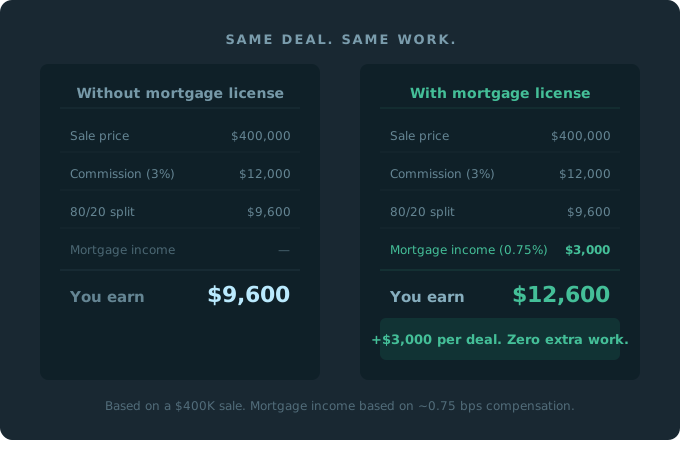
The mortgage income doesn’t replace real estate commissions. It layers on top of them with almost no added expense.
Josh used a straightforward example. If you’re at an 80/20 commission split with your brokerage, adding mortgage compensation means you’re effectively making 115 or 120 percent of what you used to make per deal, with no real change to your overhead.
The licensing cost itself is comparable to a real estate license. One closed mortgage deal per year covers all expenses associated with maintaining the license. Everything above that is near-pure profit.
“There’s nothing else out there where you can do something like this and infuse this much money into your bottom line with virtually no expense and not have to change your model, other than the order in which you do things,” Josh said.
Don’t Wait Until Your Team Is Big Enough
Josh’s biggest regret is that he waited too long to start.
His original logic was that he needed to scale his real estate team to a certain volume before it made sense to add mortgage. Looking back, he says that thinking cost him years of compounding income.
“I wish I would have grown those things together at the same time,” he said.
The programs available today, particularly through NAF’s division built specifically for dual-licensed agents, are dramatically more accessible than what existed five or ten years ago. The operational infrastructure is already in place. The compliance support is there. The loan officer pipeline is built.
His advice to anyone considering it: start sooner. There’s a learning curve to the language, the process, and the approach. The sooner you build those muscles, the faster the whole system starts to compound.
Every Objection Is a Money Conversation
There’s another benefit Josh didn’t anticipate when he started: it made him a better real estate agent.
Being fluent in mortgage changes how you handle objections. Every sales objection, he argues, traces back to money. Interest rates are too high. The market is bad. Now isn’t the right time. These aren’t reasons to hang up; they’re invitations to a different kind of conversation. But only if you know enough about financing to have it.
“If you’re not comfortable talking about money, you’re not going to be comfortable overcoming objections,” Josh said.
He describes it as carrying a full tool belt. When a buyer says rates are too high, he can pull out a tool for that. When someone says they’re not sure they can qualify, he has another. Being versed in mortgage means he never has to deflect or change the subject. He can meet the objection head-on and move toward a consult.
His team now runs weekly conversion calls every Wednesday, attracting between 30 and 90 participants. The calls cover exactly this: how to have money conversations, how to set lending consults, and how to convert more leads whether mortgage is part of the conversation or not.
How to Get Started
The licensing process goes through the NMLS national exam. Unlike real estate licenses, mortgage licenses are national by default, with some states requiring a short additional course for state-specific licensing. Many states require only purchasing the state license after passing the national test. The process runs through Mortgage Educators for the course work, and the whole thing is handled online.
Josh operates under New American Funding, which he says has built the most developed program in the country for dual-licensed real estate agents. He’s been at five other places before landing there. His recommendation is to reach out, set up a discovery call, and work through the questions from there rather than trying to figure it out alone.
NAF carries over 2,200 loan products. That depth matters when you’re working a varied lead base, because some buyers will have preferences or constraints that require specific products to make a deal work.
FAQ: Questions from the Webinar
Can I just take a referral fee from a mortgage company instead of getting licensed?
No. Accepting a referral fee from a mortgage company without a license is a federal violation. Licensing is required before any compensation can flow.
Do I have to pass a separate exam for every state?
The core exam is the NMLS national test, taken once. Some states require a short supplemental course or additional paperwork for their state-specific license, but most are straightforward to add once you hold the national credential.
How much of my time does managing mortgage actually take?
For Josh, it comes down to signing a loan disclosure, which takes about 40 seconds per file. The LO and their assistant handle everything else.
How much does it cost to get and maintain a mortgage license?
The licensing costs are comparable to a real estate license. The annual renewal involves some online continuing education. One closed mortgage deal per year is enough to cover all associated costs and still come out ahead.
What if I already have an LO I work well with? Do I have to switch?
Not necessarily. Josh has helped agents bring their existing LO into the program with them. It depends on the situation, and he works through the options with each person individually.
How much can I expect to earn per loan?
Compensation is structured in basis points (bps). A general rule of thumb is around 75 bps, or three-quarters of a percent, though it varies based on volume, how much of the process the agent handles, and other factors. The structure gets worked out during the setup conversation.
What if some of my clients are already committed to a specific lender?
It happens. Some buyers come in pre-attached to Veterans United, USAA, or another lender they’re not going to leave. That’s fine. You still get the real estate side, and NAF’s 2,200 loan products mean you’re covered for clients who don’t have that kind of preference.
Do all the agents on your team hold mortgage licenses?
Josh’s whole team operates with a mortgage-first approach. The scripting is built in, and agents who prospect use it because a lending consult is an easier and more concrete close than going straight for a buyer’s appointment.
What’s your conversion rate on CINC leads?
Josh pushed back a little on the framing of that question. His team just converted a lead that had been in the database for 2,800 days. “My philosophy is they buy, or I die, or they die. Until then, I’m not giving up on them.” The system keeps leads in play, and mortgage gives you a new way to have conversations with people you’ve never been able to reach before.
How do I get in touch with Josh to learn more?
Josh does one-on-one discovery calls with anyone who wants to explore this. After that initial call, he brings in Jamie, his contact at NAF’s dual-license program, who walks people through the process from there. He also runs weekly conversion calls every Wednesday that are open to anyone. Email him directly to get a link.